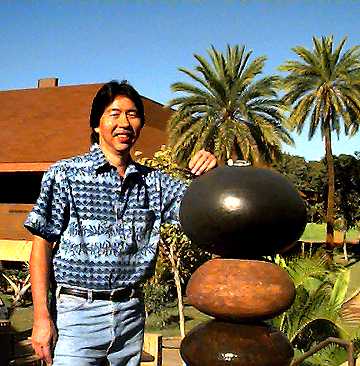
Welcome to Kapi`olani Community College (KCC) and the TCC Conference. Virtually,
indeed! Let me assure you that the sky is blue and clear. The palm trees
are green and swaying in our trade winds. Our campus is bathed daily by
the warmth of the rising and setting sun.
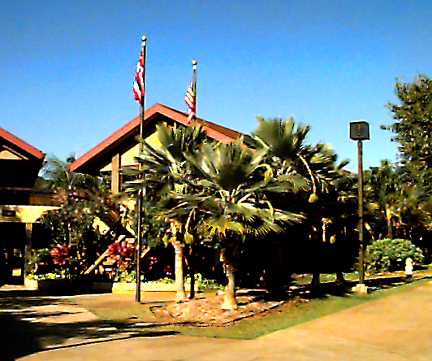
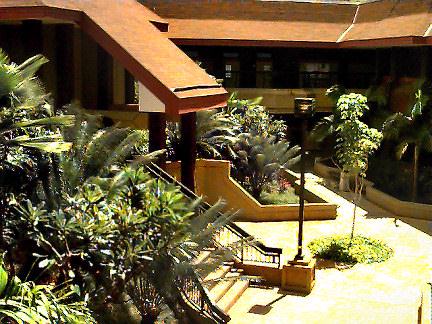
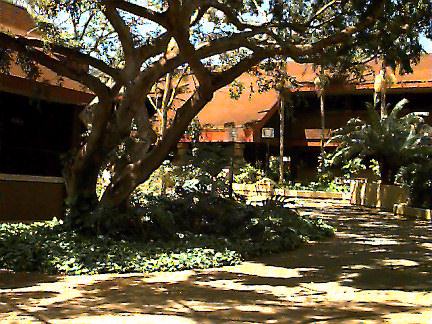
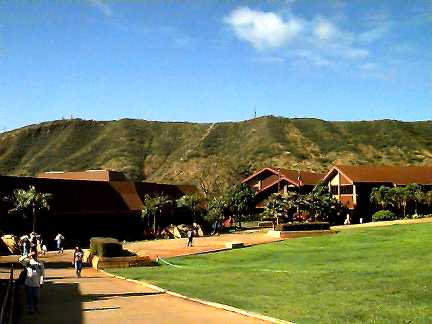
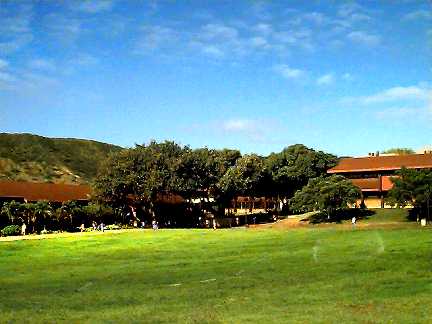
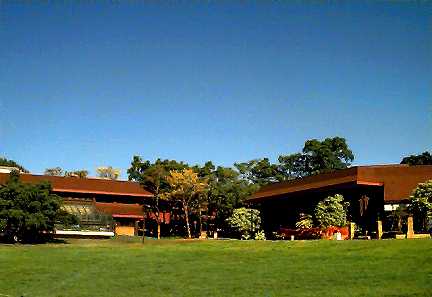
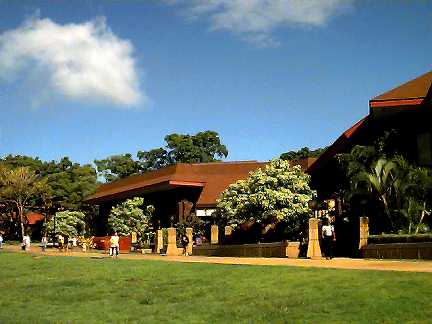
(Bottom, L-R) Cafeteria & Admin. (Diamond Head in bkg.), Campus Quad,
Science & Language Arts, Language Arts & Library
I am extremely pleased that over 600 of you are participating in this premiere
on-line and real time conference. We hope that this experience will be unique,
memorable, and worthwile. We certainly want you to meet, mingle, and share
your thoughts with each another.
There is no question of the potential value of the Internet and computer
mediated communications (CMC) for student learning. The 'Net provides unlimited
opportunities for collaboration, cooperation, interaction, support, empowerment
and student centered learning opportunities. Much of your on-going discussion
on the TCC discussion group attest to this. The question that we all are
struggling with are, "What's the best way to do it?" Or, "What will work well and what won't." It is also clear that experiment, thought, ethics,
values and human nature are important ingredients for using these technological
advances effectively in education.
The Naio Educational Media Center actively supports growing faculty interest
in the Internet. Beginning last summer, 60 University of Hawai`i Community
College faculty participated in the Hawai'i
Education and Research Network (HERN) Institute to find ways for using
the Internet effectively in education. Secondly, the Advisory Group of KCC's
Computing Across the Curriculum emphasis proposes to change the direction
of KCC's efforts from the computer assisted instruction (CAI) technology
of the 1980s to the information technology (IT) directions of the 90s. For
details, see Kapi`olani Information
Technology Emphasis (KITE ). We anticipate full implementation of the
concept this fall after extensive discussion among students, campus departments
and the faculty senate.
Overall, the Media Center supports faculty and staff with printing and duplication,
computer and audiovisual maintenance and repair, distance education, academic
computing, and faculty workshops and seminars. We publish an online bulletin
to keep faculty and staff abreast of the changing nature of information
technology and its impact on teaching and learning. To view our bulletin,
point your favorite web browser to The
Naio News Network (TN3).
We encounter many challenges during this time of shrinking budgets and rapidly
advancing technology. It hasn't been easy to provide the diversity and depth
of support that the staff wants. Personally I have found that it is most
important to focus on who we are and what we are here for, to know what
we do as a team and how effective we are, to set priorities agreeable to
EMC staff, and to strengthen partnerships with our campus community. In
other words, we must continue to pay attention to how we work with one another
and how we relate to people -- and not just pursue the "latest and
greatest" computers and peripherals.
I wish to extend many thanks and congratulations to the energy and effort
of the conference staff: Dr. Jimmy Shimabukuro, Kenwrick Chan, Judi Kirkpatrick,
Ann Flanigan, Suzy Hill, Patrick Bjork, Nadine Burke, Ramesh Gaonkar, Jay
Wootten and others who have contributed to this event, including our keynotes
and paper presenters. I recognize the historical significance of this event
and am extremely happy to be a part of it.
So I am here and you are there and we are ... everywhere! Best of luck.
Just go for it!
-Bert :-)
PS. In the spirit of international conferences, I've arranged eleven "field
trips" while you visit us on the WWW. All for free. No better bargain
available!